Nov 3, 2026 · Knowledge & Guides
Schedule 40 vs Schedule 80: Choosing Wall Thickness for Pipe Nipples
A practical guide for buyers and engineers on choosing between Schedule 40 and Schedule 80 wall thickness for threaded pipe nipples: what the schedule number means, how much the walls differ, when SCH80 is required, how the bore affects flow, where the cost comes from, black versus galvanized finish, and the fields to state on a purchase order.

Ordering a pipe nipple looks simple until the wall thickness question appears on the requisition. Schedule 40 and Schedule 80 are the two answers most buyers choose between, and the choice affects pressure capability, weight, cost and delivery. Here are the questions we hear most often. Qingdao Kaixin Machinery has made carbon steel and stainless steel nipples and fittings in Qingdao since 2003, supplying building services, industrial piping and fluid transfer in Europe and North America.
What Does the Schedule Number Actually Mean?
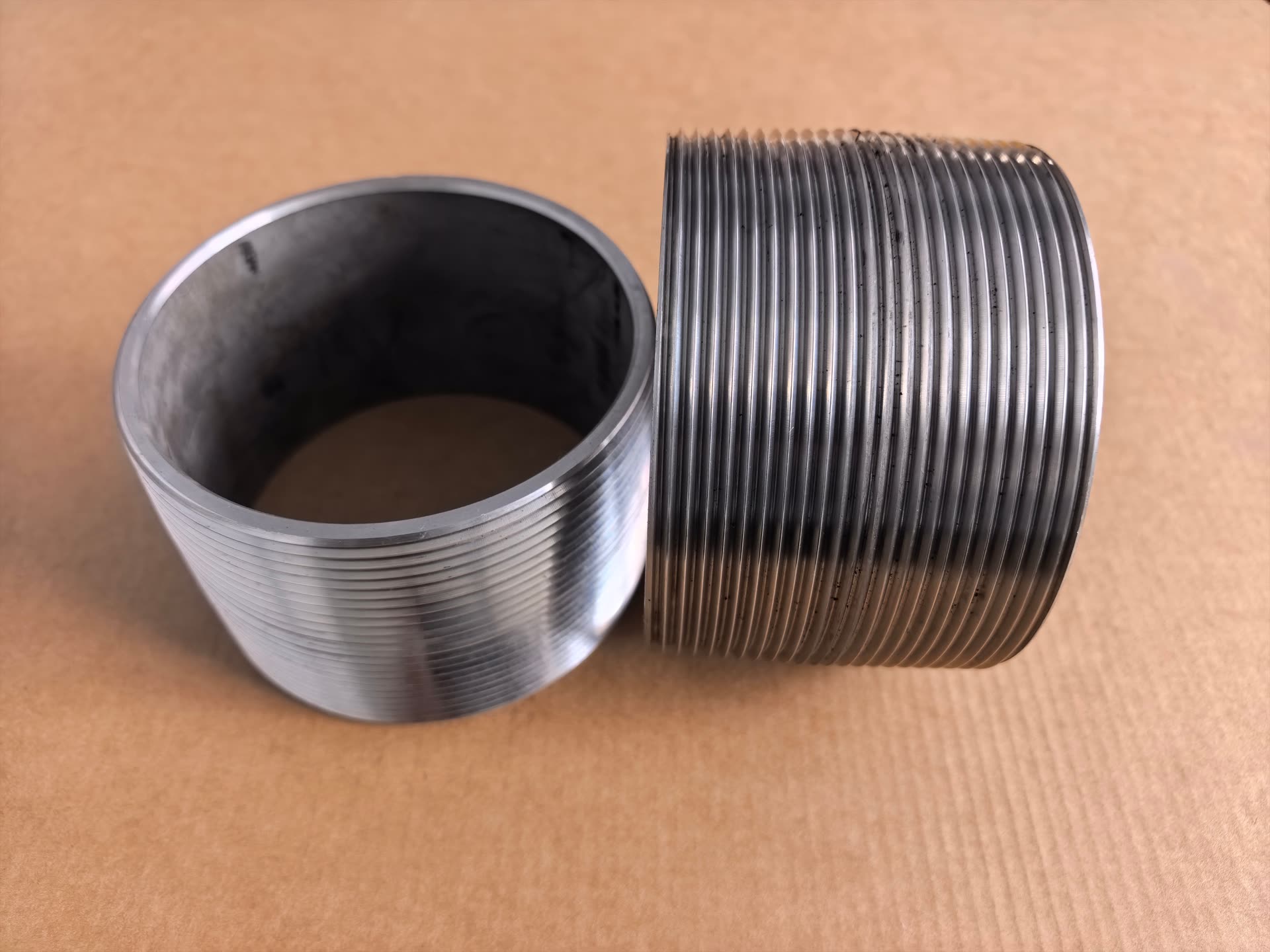
Schedule is a wall thickness designation, not an outside diameter and not a pressure class by itself. For a given nominal pipe size the outside diameter is fixed by the dimensional standard while the wall changes with the schedule. That is why SCH40 and SCH80 nipples of the same size fit the same coupling: the threads are cut on the same outside diameter, so only the bore changes.
For wrought steel pipe the schedule system is published in ASME B36.10M; nipples fall under ASTM A733 for welded and seamless steel and stainless nipples.
How Much Difference Is There Between Schedule 40 and Schedule 80?
At nipple sizes the gap is meaningful but not dramatic. Nominal wall values from ASME B36.10M:
| NPS | SCH40 wall (in) | SCH80 wall (in) |
|---|---|---|
| 1/2 | 0.109 | 0.147 |
| 3/4 | 0.113 | 0.154 |
| 1 | 0.133 | 0.179 |
| 1 1/2 | 0.145 | 0.200 |
| 2 | 0.154 | 0.218 |
| 3 | 0.216 | 0.300 |
| 4 | 0.237 | 0.337 |
Two points follow. Schedule 80 runs roughly 25 to 40 percent thicker in the wall at these sizes, giving a heavier piece and a smaller bore. And threaded-joint pressure capability depends on pipe wall and fitting rating together: a heavier nipple does not upgrade a light-duty fitting.
When Must You Specify Schedule 80?
There is no universal rule; the answer comes from design pressure, design temperature and the rating standard in force. SCH80 is specified in these cases:
- Design pressure and temperature exceed what a Schedule 40 wall can carry with an acceptable margin.
- The joint is threaded and the line is critical — threading removes wall at the section carrying the load, so a heavier wall leaves more metal at the thread root.
- The part sees mechanical damage, vibration, water hammer or repeated handling, as at pump connections, hose stations and manifold edges.
- A corrosion allowance is needed, so extra wall is bought as sacrificial metal.
- The project specification calls out SCH80 across a whole system, common in process piping where spare consistency matters more than piece savings.
Schedule 40 remains the default for low-pressure water, drainage and HVAC lines with modest design conditions.
Does a Thicker Wall Reduce Flow?
Yes, slightly. Because the outside diameter is fixed, a Schedule 80 nipple has a smaller inside diameter, so it carries less flow at the same velocity and produces higher pressure drop per unit length. On a short nipple the loss is small, but it accumulates over a run with many fittings.
If a line is already marginal on velocity or pump head, moving a long run of small nipples to SCH80 reduces the bore and raises velocity further, increasing erosion and noise. Size the bore for flow first, then choose the wall for pressure and mechanical duty.
Where Does the Cost Difference Come From?
Cost follows mass, not the schedule label. A Schedule 80 nipple contains more steel, weighs more, takes longer to cut and thread, and costs more to pack and ship. In carbon steel the material share is moderate, so the premium is usually a sensible percentage; in stainless the alloy cost dominates and the same wall increase becomes a noticeably larger number.
Freight is easy to overlook. A carton of SCH80 nipples is heavier than the same count in SCH40, and on air or express shipments that weight can matter as much as piece price.

Black or Galvanized — Which Should You Order?
Black nipples are the default for gas, oil, closed-loop systems and welded assemblies, and for parts that will be painted later. The plain surface is easy to weld and inspect.
Galvanized nipples suit water service and exposed locations with mild moisture exposure. The zinc is applied to the finished part, and the thread is the detail that matters: cutting threads in the field exposes bare steel, and those areas need attention in a corrosive environment. Galvanized parts should not be welded without stripping the coating from the weld zone.
What Should Be Written on the Purchase Order?
A clear order prevents most disputes. State each of the following:
- Nominal size, for example 1 in or 2 in NPS.
- Schedule or wall: SCH40, SCH80, or an explicit wall in millimeters or inches.
- Length and type: close nipple, running nipple, or a stated overall length with thread length.
- End configuration: threaded both ends, threaded one end, or plain both ends.
- Thread standard: NPT to ASME B1.20.1 for North America, or BSP to ISO 228 or ISO 7 for Europe and export markets.
- Material and grade with the product standard, for example carbon steel to ASTM A733 or the stainless grade your specification names.
- Finish: black, galvanized, or pickled and passivated for stainless.
- Quantity, marking and packaging instructions if the parts go to a job site.
Send the line item exactly as specified, and ask for a confirmation drawing before production when the thread standard or length is unusual. Qingdao Kaixin Machinery makes carbon and stainless steel nipples and fittings with NPT and BSP threads and supports OEM and ODM work.